Archive for September, 2025

Noise Engineering Intros Mimetic Digitwolis
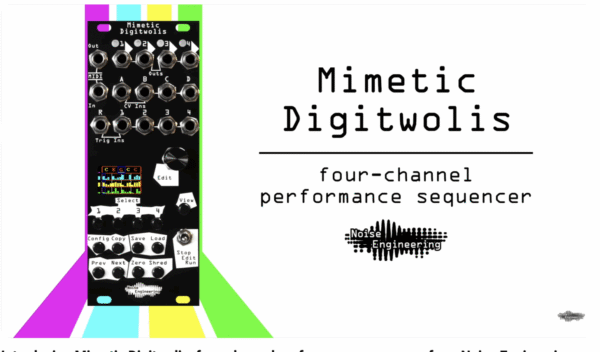

This week, Noise Engineering announced the opening of preorders for Mimetic Digitwolis. Mimetic Digitwolis (MD2) is the sequel to the Mimetic Digitalis, Noise Engineering’s classic Cartesian performance sequencer. MD2 builds on the concepts but updates the feature set dramatically, making it an incredible performance sequencer for Eurorack.

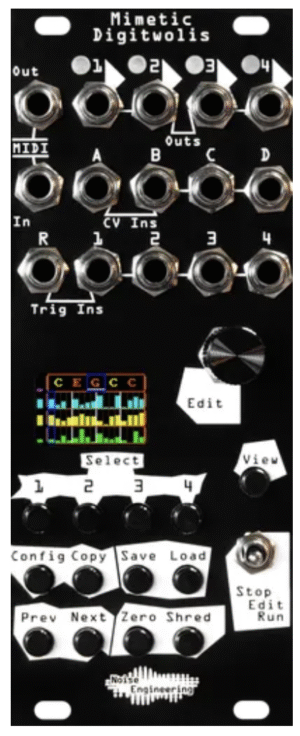
This upgraded second edition features individually configurable inputs and outputs, customizable quantizers for both internal and external signals, internal sequence-length and clock divisions, triggerable step randomization, an internal clock, MIDI, and a whole lot more, all on a completely revamped interface.

New features include:

  • Completely configurable interface: customize trigger ins, CV ins, and outputs
  • Sequence CV, triggers, or gate signals
  • Use the internal quantizer to generate sequences or quantize external CV
  • Edit quantizer scales manually or with a MIDI keyboard
  • Infinite sequencing possibilities: trigger step randomization, navigate across different dimensions, or use CV to address sequences – or some of everything!
  • User-requested features like new output types, internal clock divisions, easy sequence editing, and MIDI capabilities
  • Generate clock internally for standalone sequencing

Like the original, MD2 is a compact 10HP.

Mimetic Digitwolis (MD2) is available for preorder for $385, and will begin shipping September 18, 2025.

More information is available on the Noise Engineering website.

 

The Demon Box EMF Instrument/Controller Ready for Preorders


Eternal Research has announced that its triangular instrument, The Demon Box, will be “ready for the world” and on sale for preorders.

Years in development, the Demon Box uses 33 inductors grouped in three triangular channels of 11 inductors to transform electromagnetic frequencies. The Demon Box can be used on its own to create unique sounds or it can be incorporated into a larger setup including as an audio-visual controller. The instrument is perfect for sound designers, composers, artists, and other creatives who want to find new ways to conjure and explore sound. It also offers ample opportunity for visual applications like video synthesis, DMX lighting, and coding platforms like Max, Jitter, and TouchDesigner.

Eternal Research founder Alexandra Fierra explains, “The Demon Box is a physical manifestation of a bigger idea. It’s an idea in contrast to the idea that all the organizing principles we’ve hitherto devised are music, and all that is not part of that is noise.” She adds, “Our goal is to bridge the gap between science and music, to turn the forces that made the electric guitar and MIDI possible into an instrument for the 21st century.”

Demon Boxes can mesh with nearly any set up, thanks to their comprehensive connectivity: three mono audio ins, three mono audio outs, a triphonic audio output, 3 control voltage outputs, and MIDI out sending CC and note data via a DIN port and USB-C. Each channel comes equipped with parameter controls, enabling you to mix both the EMF channels and external gear to your liking in real time.

According to Eternal Research’s head engineer Bryn Nieboer, “Stereo is limited. Three channels allow you to sculpt and navigate with panning, phasing, and effects layering, to create an immersive, triphonic sound that sets the Demon Box apart.”

The Demon Box ($999.00) is available for preorder now at this link, and is expected to ship later this autumn. Eternal Research is offering a special discount of $100 off the $999.00 original purchase price of The Demon Box that runs September 5- 13, 2025. The offer can be used once per Demon Box transaction with the code DEMON33.

The Demon Box and other Eternal Research projects will be part of this year’s Knobcon in Chicago on September 5-7, 2025. They will be available for Knobcon attendees to explore at the Eternal Research booth B400.


WAVS Launches ‘Industry First’ AI-powered Sample Discovery Tool, AI Sample Finder


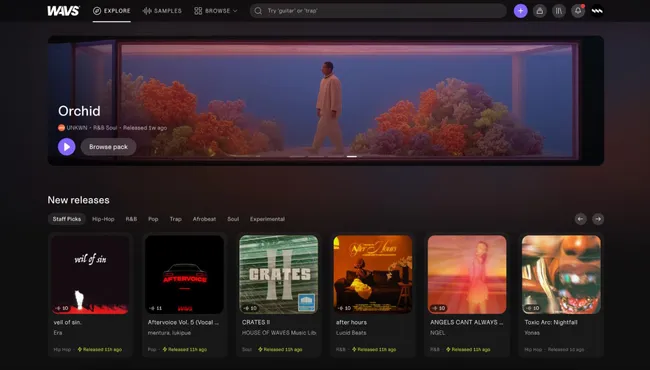
WAVS has launched AI Sample Finder, an AI-powered sample discovery tool that enables users to search for samples from its library that are similar to an uploaded audio file.

The AI Sample Finder can be accessed via WAVS’ browser-based platform and its VST/AU plugin, so music-makers can drag-and-drop any sample from their timeline into the plugin to search for similar sounds without leaving the DAW and breaking their creative flow.

WAVS promises that AI Sample Finder will empower creators to “explore and experiment with samples in innovative new ways”, searching for stems, loops and one-shots that align sonically with an existing project and discovering sounds that resemble their favourite samples and synth patches.

Other uses for AI Sample Finder suggested by WAVS include uploading a portion of a reference track to find samples that sound like a particular artist, or even recovering lost samples from corrupted projects by dropping an early bounce into WAVS to find the original sounds that were used.

Alongside the AI Sample Finder feature, WAVS’ library can also be searched and filtered based on categories such as mood, energy, genre and instrumentation. The WAVS plugin syncs up with your DAW project to allow you to quickly and easily audition sounds in the appropriate key and tempo before dropping them into a track.

WAVS is a sample marketplace with an extensive library of over 100,000 sounds, almost half of which are royalty-free. The remainder can be used according to a unique royalty structure whereby sample clearance is only required after a track that uses a sample reaches 1m streams or is released via a major record label.

WAVS is describing AI Sample Finder as an “industry first”, and while this type of AI-based sample discovery isn’t entirely new, WAVS’ implementation of the technology is a little different to its competitors.

Loopcloud offers an AI-powered similarity search via its Loopcloud Sounds plugin that digs out sounds from its own library that are similar to a chosen sample from the user’s library, but this requires the sample to be loaded into Loopcloud’s desktop app before it can be accessed in the plugin – there’s currently no drag-and-drop function available.

Splice’s Search with Sound feature, currently in beta, also allows users to upload their own audio to assist with discovering samples from its library, but instead of identifying similar sounds, Splice’s feature searches for compatible sounds that could be layered into to a project to complement the given sample, based on analysis of its rhythm and tonality.

WAVS is a credit-based subscription service starting at $8.99/month for the Starter tier, $13.99/month for the Pro tier and $19.99/month for the Elite tier. The WAVS plugin is compatible with macOS and Windows and available in VST/AU formats.

Find out more on WAVS website.