Developer Oliver Greschke (Elastic Instruments) has updated Elastic OSC for iOS to add support for DX7-style FM synthesis.
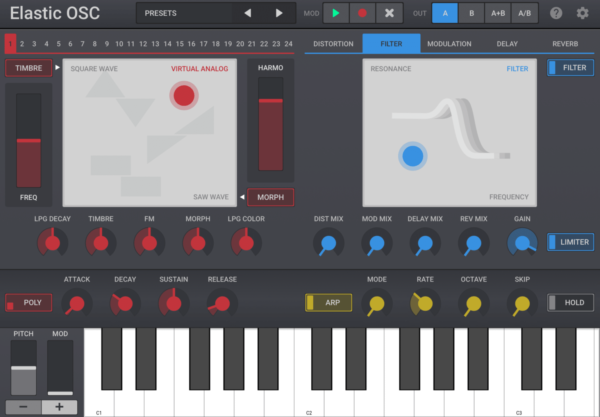
Elastic OSC is an 8-voice polyphonic synth for iOS, largely based on the voice engines of the Mutable Instruments Plaits’ Eurorack module.
Update 1.1 allows you to import DX7 banks into the 3 OP6 engines (19–21). Each OP6 preset / DX7 bank consists of 32 DX7 sounds, which you can switch through using the Harmonics slider.
The update also includes a wide range of DX7 sound libraries, including classic DX7 presets, patches by sound designer Jexus and more.
New in Elastic OSC v1.1:
Added DX7 Bank and Wavetable Import: Import DX7 banks from one of the many online sources, create new ones via the Generator link, or edit your bank on the Plaits Sound Editor website
Added dozens of new presets from sound designer SOI and a new Artist Category for SOI sounds
Added Preset Compare feature: instantly switch between the current and original preset version
Improved preset saving: the current preset name now appears in the text field above the SAVE button, making it easier to edit
Bugfix: fixed audio hum/engine issue that sometimes occurred when opening the app
Bugfix: incorrect layout on iPad Pro with 13-inch screen
Improvement: knobs respond more sensitively now
Improvement: harmonics slider now has 32 steps for OP6 engines (reflecting DX7 preset switches) instead of linear values
Bugfix: Improved DX7 envelope behavior – the app now more accurately reflects the envelopes of DX7 presets. Some of your OP6 presets might sound a bit different, but they are now much closer to the original hardware sound”
We have known about the existence of Elektron’s Tonverk since leaked images of a prototype unit appeared online almost a year ago.
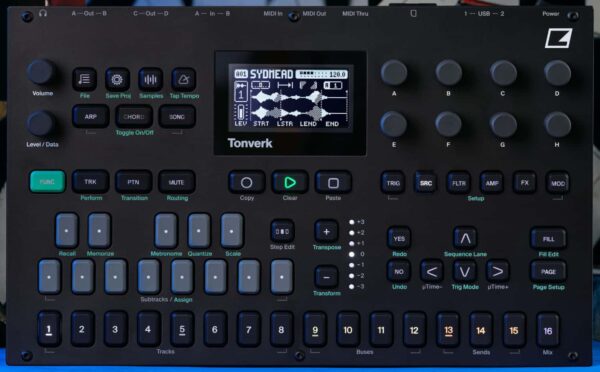
Today, Elektron officially introduced Tonverk, a new polyphonic multisampler and audio processor.
The Elektron Tonverk has eight audio tracks that can be used in a variety of ways. There are a further eight tracks for buses, sends, and mix. Each of the 16 tracks has its own sequencer.
Tonverk offers polyphonic stereo sampling, multisampled instruments, tracks within tracks, flexible routing, a kaleidoscope of effects and modulation, and the extended 256-step Elektron sequencer.
The Elektron Tonverk features three sound creation machines, plus another for MIDI.
Each audio track can work in one of three ways, making use of Elektron’s system of playback ‘machines’. The first of these is the Single Player machine, which lets users record and playback both mono and stereo samples polyphonically, with the ability to adjust sample length and playback behaviour, as well as set loop points and crossfading.
The second machine mode is labelled Multi Player, which allows Tonverk to create and load multi-sampled instruments that can be played back polyphonically. To make full use of this, Tonverk introduces an Auto Sampler function, which uses MIDI to automatically multi-sample hardware instruments.
The final audio track mode is called Subtracks. This allows each audio track to play host to eight individual monophonic sample players, each with its own sample parameters and sequencer track. This allows a single audio track to be used as a full drum kit or a means to layer monophonic ideas.
Audio tracks can also function as a MIDI track for controlling external gear.
Each of these tracks can make use of what Elektron describes as ‘a kaleidoscope of effects and huge modulation possibilities’. In practice, that equates to features including two assignable LFOs and two effect LFOs per audio track, an assignable envelope for each audio track, plus two LFOs for each bus/send track. There’s also a flexible mod matrix for routing pitch bend, mod wheel, breath control and aftertouch.
On the effect front, Tonverk has a total of 17 modules available across its various track types (options differ from track to track). Many of these are new for Tonverk, and feature enticing titles such as Infinite Flanger, Phase 98, Dirtshaper, Chrono Pitch and Supervoid Reverb.
In typical Elektron fashion, each of Tonverk’s tracks can be controlled using a deep and flexible step sequencing workflow. Tonverk’s sequencer can program up-to 256 steps per track and comes equipped with functionality including parameter lock automation, an arpeggiator, probability-based sequencing, per-track sequence lengths and micro-timing adjustments.
According to Elektron: “Whether you’re multi-sampling your favorite synth, crafting drum kits, routing things all over the place or sending sounds out and back in for further alchemy, Tonverk is made for expansive sound design and immediate play.”
With its ability to save fully-fledged multi-sampled instruments and multi-part drum kits, as well as its routing and sequencing tools, Tonverk looks like the closest thing Elektron has released to a true ‘DAW in a box’ system.
The obvious question is whether or not Tonverk is intended as a replacement for Elektron’s similarly-priced Octatrack. On paper, Tonverk looks a lot like an upgrade to the Octatrack’s eight-track design; keeping the stereo sampling but expanding it with new modes and internal routing options.
in addition, Tonverk lacks some popular Octatrack features such as its crossfader and, at first glance at least, appears to put less emphasis on live performance and more on studio functionality.
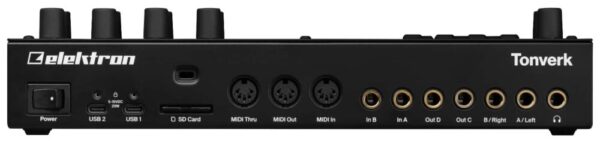
In terms of the Tonverk hardware itself, the rear panel features four balanced jack outputs, two balanced jack inputs, a stereo headphone output, and MIDI in, out and through ports. There’s also an SD card port providing expandable memory, along with two USB-C ports.
Tonverk can function as a class compliant USB audio device. There’s currently no word on compatibility with Elektron’s Overbridge software.
Tonverk will come loaded with a sound library containing single samples, multi-sampled instruments, drum kits and preset projects.
Here’s an overview of the Tonverk:
Features:
8 voices per audio track
4 × selectable machines per audio track:
Single Player
Multi Player
SubtracksMIDI (also selectable on the bus tracks)
8 × stereo audio tracks
4 × bus tracks
3 × send effect tracks
1 × mix track
1 × digital base-width filter per track/subtrack
2 × assignable LFOs per track
1 × assignable modulation envelope per voice
2 × assignable FX LFOs per audio track
2 × assignable LFOs per effect bus, send effect, and mix
Modulation setup per track for pitch bend, mod wheel, breath control, aftertouch
Step Edit
Extensive routing options
Diverse sound library (single samples, drum sets, multi-sampled instruments, and pres
MIDI track features:
16 note polyphony per step
16 × assignable CC controls
2 × assignable LFOs per track
Performance features:
2 × Trig modes
Tracks
Velocity
Keyboard mode with 36 different scales
Song mode
Chord mode
Sequencer features:
Up to 256 steps per pattern and track
Arpeggiator per audio & MIDI track
Polyphonic sequencing
Individual pattern length per track
Individual time scale multiplier per track
Parameter locks
Trig conditions & trig chance
Retrig (audio & MIDI tracks only)
Micro timing
Sequencer lanes
Effects:
Comb +/- Filter
Filterbank
Low-pass Filter
Multimode Filter
Infinite Flanger
Panoramic Chorus
Phase 98
Warble
Chrono Pitch
Frequency Warper
Compressor
Degrader
Dirtshaper
Daisy Delay
Saturator Delay
Rumsklang Reverb
Supervoid Reverb
Hardware:
128 × 64 pixel OLED screen
4 × ¼” impedance balanced audio out jacks
2 × ¼” balanced audio in jacks
1 × ¼” stereo headphone jack
48 kHz, 24-bit D/A and A/D converters
2 × USB-C port
MIDI In/Out/Thru with DIN Sync out
SD Card slot
Physical specifications:
Sturdy steel casing
Dimensions: W 286 × D 176 × H 63 mm (11.3? × 6.9? × 2.5?) (including knobs and feet)
Weight: approximately 1.85 kg (4.08 lbs)
100 × 100 mm VESA mounting holes. Use M4 screws with a max length of 7 mm
Miscellaneous
Class Compliant USB Audio
External Input mixer with routable outputs
3 year Elektron warranty
Included in the box:
64 GB SD card
Power Supply PSU-5
Elektron USB-C cable
Exclusive artwork
Tonverk is the first device of in Elektron’s latest platform and the say “certainly not the last”.
Check out the details and share your thoughts on the Tonverk in the comments!
The Elektron Tonverk is priced at $1,599 / €1,399/ £1,199. It’s currently listed as ‘out of stock’ at the Elektron site, but retailers are starting to list it for pre-order.
The Bob Moog Foundation has unveiled its fall fundraising raffle.
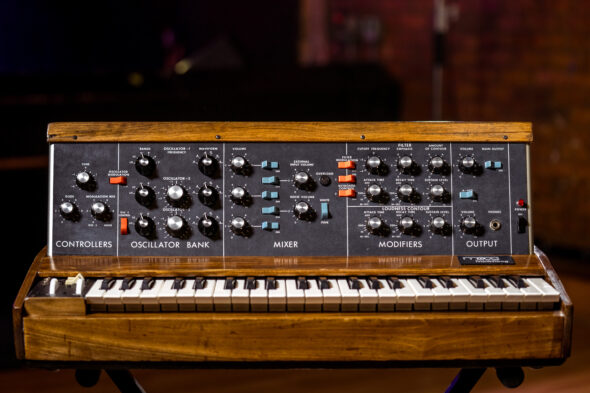
Now through September 29, the BMF is raffling a fully-restored vintage Minimoog Model D synthesizer, serial number 4605, originally manufactured in Moog Music’s Williamsville, NY factory in the early 1970s. This Minimoog was restored by current Moog Music engineer Tim Johnston.
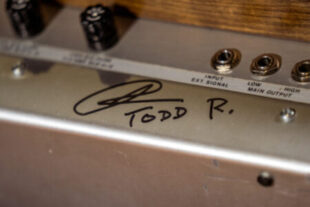
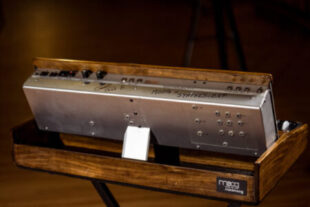
The legendary sound of the iconic Minimoog spans decades of popular music, including the early synthesizer works of Todd Rundgren, who signed the Minimoog while also inscribing “Moog = Synthesizer” on the back of the synth. The Minimoog is valued at $6,500.
Since its first commercial use in 1970, the famed Minimoog has been a timeless interplay of engineering, artistry, and creativity. It offers a wonderfully accessible configuration of targeted modules similar to those used in famed Moog modular synthesizers, one of which, the Moog System 55, was employed with epic effect in the mid-1970s by Rundgren and keyboardist Roger Powell while recording and performing in the band Utopia, as well as in Rundgren’s solo efforts.
Todd Rundgren is a prized member of the musical community, having written and performed on seminal classic hit songs including Can We Still Be Friends, Hello It’s Me, and the iconic Bang the Drum All Day. His production credits include a mind-bending collection of notable artists and bands. Among them are The Tubes, Patti Smith, Grand Funk Railroad, Hall & Oates, Badfinger, The Psychedelic Furs, Sparks, Cheap Trick, and Meatloaf (Bat Out of Hell). The Minimoog that carries Todd’s signature represents his storied history that helped to shape an entire generation of music.
“The Moog modular synthesizer and the Minimoog helped define my sound,” noted Todd Rundgren. “I am thrilled to have signed this fully restored vintage Minimoog for the Bob Moog Foundation in support of their educational efforts, including Dr. Bob’s SoundSchool, which inspires thousands of elementary school students through sound every year.”
Raffle tickets are $25 each, 5 for $100, 12 for $200, and 35 for $500. Buy tickets here.
Funds raised from the raffle will be used to expand the Bob Moog Foundation’s hallmark educational project, Dr. Bob’s SoundSchool, which has inspired over 35,000 elementary school students through the science of sound. The raffle also helps support the Bob Moog Foundation Archives and the Moogseum, an immersive, experiential museum located in Asheville, NC, which brings the science of sound and synthesis alive for people of all ages through Bob Moog’s pioneering legacy. The Moogseum opened in May 2019 and has since welcomed over 45,000 visitors from all over the world. The museum is still recovering from the long-term financial impact of Hurricane Helene.
The raffle begins Monday, September 8th at 7:00 am EST and ends 11:59 pm EST Monday, September 29th, 2025. Raffle tickets are $25 each, 5 for $100, 12 for $200, and 35 for $500 and can be purchased at this link. The raffle is open internationally. More information is available on The Bob Moog Foundation website.