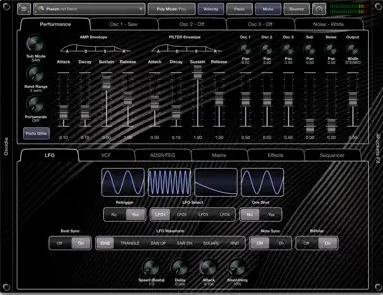
4Pockets has introduced Oscidia, a new AUv3 wavetable synthesizer for iOS.
Oscidia offers a wide range of features and oscillator types, allowing it to produce a vast variety of sounds. Oscidia has 3 oscillators per voice, and each oscillator can be a different wavetable.
Oscidia also supports 5 filter types, which support 12/24dB modes and morphable LP/BP/HP filter modes, which can be automated from the Mod Matrix or via the Sequencer.
The built-in sequencer allows up to 3 simultaneous ARPs to play at the same time. Each ARP can directly control the 3 oscillator levels independently per step, as well as the pitch, filter morph, cutoff frequency, probability, gate, note repeat and ties. This allows for some really complex rhythms to be created that are not tied to pitch.
Features:
3 Oscillators Per Voice.
Support for Wavetable and Additive synthesis.
WaveTable supports Morph and Warp (Phase Distortion) features.
4 LFOs Per Voice.
5 Filter types with 12/24-bit slopes and morphable LP/BP/HP.
Alex Theakston of Mylar Melodies – in his latest video – takes an in-depth look SoundThread, a free, open-source audio-mangling tool for Linux, Mac and Windows.
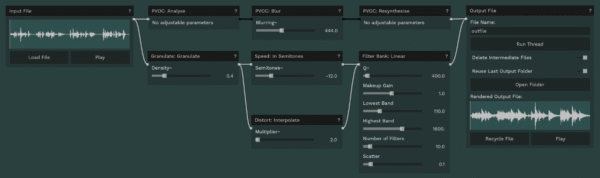
SoundThread is a cross-platform user interface for The Composers Desktop Project (CDP) suite of sound manipulation tools. It allows for modular style routing of various CDP processes to quickly build up complex Threads that allow for extensive sound manipulation. CDP has been notably used by Aphex Twin, as noted in the video.
The goal of SoundThread is to make CDP as user friendly as possible and it is particularly well suited to those new to experimental sound processing.
In the video, Theakston explains what SoundThread can do and demonstrates how it works.
Video Summary:
“Prepare to meet SoundThread – capable of the most insane sound mangling imaginable – and it’s completely free.
You might know of Composer’s Desktop Project, used by our old pal Aphex Twin on Drukqs. CDP is one of the most powerful software sound design tools on Earth, and is free. It can do things you just can’t do elsewhere. Problem is, CDP has never been especially easy to use.
Enter SoundThread – a new, beginner friendly Mac/Windows/Linux “front end” for CDP. SoundThread gives you access to lots of CDP’s power, but in a simple drag-and-drop modular way. It makes it fun and quick to explore, even if you have very limited experience – that’s a big deal. CDP has never been this easy before. This video was made completely independently of SoundThread & CDP – if I find something cool, I just want to spread the word.”
Topics covered:
00:00 Why is this important?
01:35 How to apply processing in SoundThread
03:22 Add automation
03:45 Filterbank example, showing mixing
05:06 Extend Sounds: Envelope Bounce
05:51 Distort: Interpolate madness
07:15 Every sound gets saved (more examples)
08:17 What Aphex did with CDP
08:56 Drukqs effect spotting
09:51 Our own version, with automation
10:18 Processing Breaks in weird ways
11:03 Putting the sound in order of volume(!)
11:53 How to PVOC for more madness
13:19 PVOC Breakmangling
14:00 Final suggestion
If you’d like to learn more about SoundThread, check out this video playlist by Jonathan Higgins:
SoundThread is available as a free download from Github.
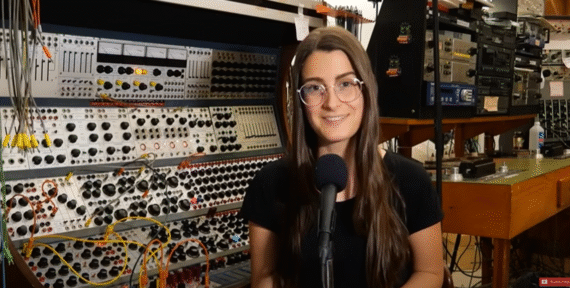
Synthesist and music educator Sarah Belle Reid – latest video – takes an in-depth look at the Buchla 200 Series modular system, aka The Electric Music Box.
While once a fairly esoteric system, the 200 Series has recently become a mainstream modular system, thanks to the collaboration between Tiptop Audio and Buchla USA to reissue the modules in Eurorack form.
Reid’s video offers a history of the Buchla 200, an overview of the system and its capabilities, and a variety of musical examples.
Topics covered:
00:00 Introduction
2:22 200 Series History
9:15 System Overview (Sound Generation)11:56 System Overview (Mixing Facilities)
13:34 System Overview (Control Voltage Generation and Processing)
17:04 200 Series Workflow Improvements
22:46 Dynamic Timbral Modification
39:44 Polyphonic Signal Generation
49:15 Spatial Location and Mixing
59:04 Complex Pattern Generation
1:10:22 Expressive Interaction in the 200
1:21:13 What is an Electric Music Box?
Video Summary:
“In the spring of 2025, musician/educator Sarah Belle Reid spent a week at the Stony Brook University Electronic Music Studio, working closely with their original Buchla 200 Series modular synthesizer. Built in the early 1970s by pioneering instrument designer Donald Buchla & associates, this rare instrument is one of the few surviving and fully intact systems of its kind. Moreover, the Stony Brook 200 Series instrument in particular has its own rich history, having been used by respected electroacoustic composers such as Bülent Arel and Daria Semegen.
At the time of its creation, the Series 200 Electric Music Box was revolutionary. Its forward-thinking design introduced new ways of shaping sound and interaction that set it apart from other synthesizers of the era. However, because so few systems were ever produced, ownership was largely limited to university studios and research centers. As a result, the instrument remained relatively obscure outside of academic and experimental music circles.
But, over the past 10–15 years, public awareness of the Buchla 200 has increased dramatically—and it has become a significant influence on the world of electronic music and instrument design. The design of the Buchla 200 has become a common point of reference and inspiration for countless contemporary instrument makers, despite the fact that a relatively small number of original 200 Series instruments were ever made.
Due to its rarity, very few musicians have had the opportunity to interact with an original 200 system firsthand. Reid’s video aims to help bridge that gap by sharing the instrument’s sound, design philosophy, and aesthetic intentions with a wider audience.
Reid’s video begins with a brief historical overview of the Buchla 200 Series and its role in the rapidly evolving landscape of 1970s electronic music. From there, she offers a detailed walkthrough of the system, exploring each module with sound demonstrations and examples. The presentation concludes with Reid’s reflections on the Buchla 200’s design philosophy, offering insights into the types of musical interaction the instrument was built to encourage (and why it continues to resonate with musicians and designers today).
This video was created in collaboration with the Buchla Archives, an organization dedicated to the thorough and thoughtful documentation and preservation of Donald Buchla’s work.”