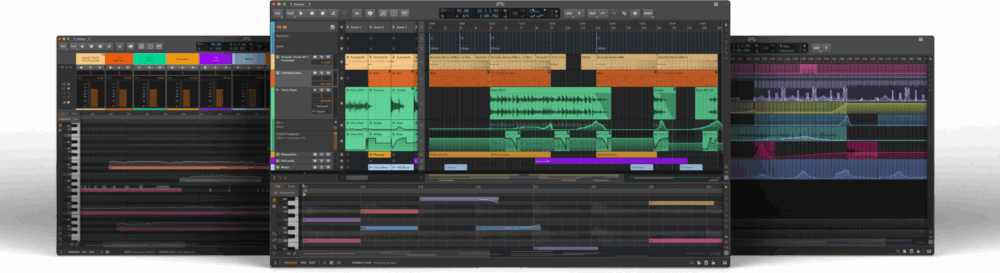
Bitwig takes its flagship DAW to ‘another level’ with Bitwig Studio 6, bringing improved automation, key signature awareness and a host of workflow enhancements.
Bitwig has introduced Bitwig Studio 6, a major update that they say improves and expands on core DAW functions.
Launching today in public beta, Bitwig Studio 6 brings with it an overhaul of automation editing, a new Clip Alias feature, project-wide key signature support, a visual refresh and much more.
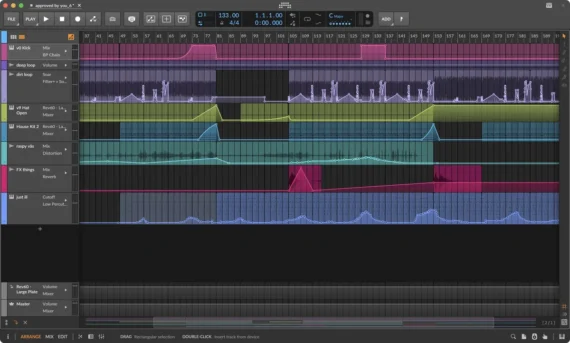
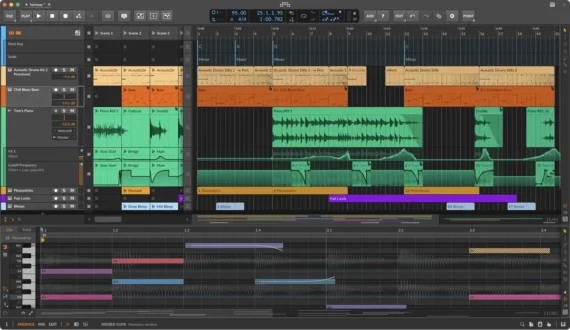
Apparently, the most noteworthy of Bitwig Studio 6’s updates is the software’s new approach to automation editing, which completely revamps the way that automation is handled within the DAW, making it both more sophisticated and more flexible.
Bitwig Studio 6 introduces a dedicated Automation Mode that instantly overlays every track on the timeline with an automation lane for the most recently tweaked parameter. The Detail Editor Panel now provides access to all of the automation on any given track, replacing the standalone Automation Editor Panel.
A trio of improved automation gestures make editing quicker and more intuitive, while new behaviours open up new avenues for creative automation. The Spread feature applies a randomised value within a chosen range to individual automation points on each pass, while the Hold option tells a point to remain at a flat value until the next one is reached.
These are complemented by an upgraded algorithm that translates automation drawn with the Pencil tool into smooth and easily editable curves.
In addition, Bitwig Studio 6 introduces Automation Clips, which store automation data in a self-contained format. This makes it possible to access the same clip features as Audio and Note Clips, such as stretching, looping and setting independent start times, and Automation Clips can even be saved to Bitwig’s library to be used in other projects.
Bitwig’s latest update also brings with it a long-requested feature that streamlines the arrangement process and solves one of the software’s most common workflow gripes: Clip Aliases. These are specialised duplicates of a Clip that share the same content, or Pattern – when one clip is edited, all clips sharing that Pattern across the Project will be updated accordingly. Clip Aliases can be used in both the Clip Launcher and Arranger, and can be created for Audio, Note and Automation Clips.
Another major new feature in Bitwig Studio 6 is project-wide key signature awareness, which opens up a variety of creative possibilities for working within scales and keys.
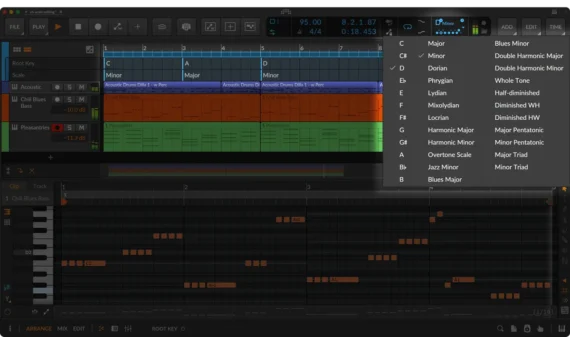
A project’s key signature can now be selected alongside tempo and time signature in the Transport section. Users are able to choose between a selection of 23 scales for any root note, including modes and blues scales, along with traditional major and minor scales. Key signature can also be automated or even modulated using Project Modulators, unlocking tons of potential for tonal experimentation.
Scales are now visible when editing notes in the Piano Roll, and existing notes can be quantized to sit within the relevant scale or snapped to a chosen scale when drawn in. Six Note FX devices have been updated to work in tandem with Bitwig’s new scale awareness, including the Key Filter device, a note transposition device that filters incoming notes to match a particular scale or key, alongside Arpeggiator, Randomize and more.
Bitwig’s visual interface has also received a refresh in version 6, becoming more customisable and efficient to use. Editing tools are now accessible from a slim window on the right-hand side, including three new tools, Audition, Spray Can and Step Input. Audition does what it says on the tin, enabling you to preview any track or clip individually with a single click. Spray Can sprays a row of notes or automation points at the currently selected beat interval, while Step Input lets you enter notes in the Piano Roll via MIDI input without hitting record.
Major changes include:
An extensive upgrade to automation editing, touching everything from smoother editing gestures to new behaviors such as spread and hold.
Automation clips, which open up new possibilities in a familiar format.
Clip Aliases – a new way to handle repetition and structure
Project-wide key signatures.
Bitwig Studio’s visual interface has been improved, making it easier to adjust to specific workflow needs.
New and improved tools, such as the Spray Can and Audition tool, join enhanced editors for both expression editing and layered editing of audio and notes.
Overall, Bitwig Studio 6 looks like a comprehensive update that makes this already-capable DAW even more powerful, bringing Bitwig users a bundle of long-requested features that promise to dramatically enhance workflows and make composition and arrangement faster and more intuitive.
Though Bitwig has a reputation as a forward-thinking DAW geared towards electronic and experimental music-makers, this update expands its appeal for a more conventional audience, focusing deeply on core DAW functionality rather than flashy new devices and modules (though users got plenty of those in recent updates) and making Bitwig Studio an even stronger competitor for more established rivals like Ableton Live and Logic Pro.
The official preview for Bitwig Studio 6:
Bitwig Studio 6 is now available as a beta release. The beta is free to all Bitwig Studio, Producer, and Essentials users with an active Upgrade Plan (as of August 27, 2025). Users will find the beta installers in their user profile.
The company is planning releasing version 6 this fall. Visit the Bitwig site for details.
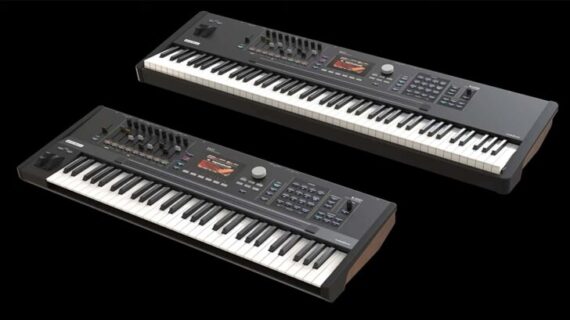
After teasing both synthesizers at NAMM earlier this year, Kurzweil has finally announced that the K2061 and K2088 – a modern update to the classic K2000 – are available to order.
Released in 1991, the Kurzweil K2000 was a 24-voice synth and sampler that, at the time, boasted some pretty powerful features, thanks to its V.A.S.T (Variable Architecture Synthesis Technology) synth engine. The K2061 and K2088 take the spirit of that instrument but use the latest tech to make them suitable for a contemporary audience.
They say, “We asked ourselves, what if we could rebuild the legendary K2000 V.A.S.T. synthesizer, but using today’s technology?”
Kurzweil’s V.A.S.T. engine has evolved significantly since its launch 30 years ago, and the new K2061 and K2088 are both modern powerhouse synths, with up to 32 layers per program and a huge 256 voices of polyphony on tap, all running from FlashPlay memory for instant load times.
The 2GB library of factory sounds spans more than 2,000 programs and over 500 multis, including a curated selection of sounds from classic Kurzweil instruments, plus another 2GB of user space for your own sounds and samples. K2061 and K2088 are compatible with standard WAV/AIFF formats and legacy Kurzweil sounds going back to the K2000.
Alongside the V.A.S.T. core you’ll find a six-operator FM engine that can load vintage SysEx patches, VA1-style virtual analogue oscillators and a KB3 organ mode with realistic drawbar control. There’s a varied arsenal of effects onboard, with over 32 effects units and 1000 preset chains, alongside a master section with EQ and compression for extra polish.
Both synths are 16-part multitimbral with 16 programmable MIDI zones, each with its own arpeggiator, step sequencer, and RIFF generator, backed by up to 40 assignable physical controls per zone, including knobs, sliders, buttons, wheels, and pedal inputs, along with a three-section ribbon controller.
The K2061 is built around a 61-note semi-weighted synth-action keybed from Fatar (TP/9) with channel aftertouch, designed for expressive synth playing. The K2088 steps up to a full 88-note, hammer-action weighted keybed (Fatar TP/40L), also with aftertouch.
Kurzweil K2061/ K2088 – Song Demos:
Kurzweil K2061 is priced at $2199/£1899, and K2088 is priced at $2999/£2175.