Archive for August, 2025

New JX2044 Analog Polysynth – Sneak Preview


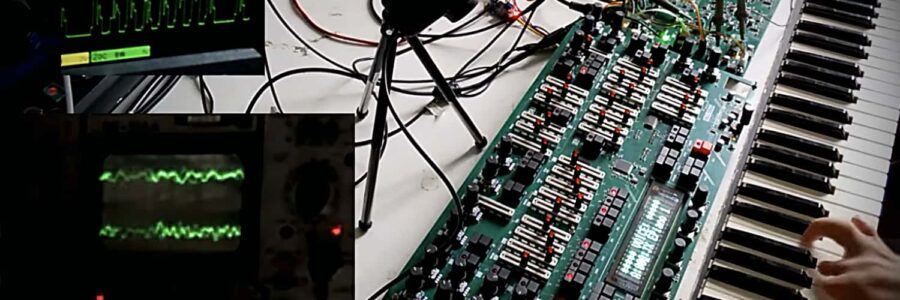
Synthesist adamstan shared this sneak preview of a new synth that he’s developing, the JX-2044.

The X-2044 is an original 8-voice bi-timbral analog synthesizer design, with a voice architecture that combines a DCO section inspired by Roland JX-8P with a 2044 filter.
Specifications:

  • 2 DCOs per voice based on JX-8P, but with addition of PWM. DCO A features sawtooth, pulse and noise, while DCO B has triangle on the last switch, instead. Waveforms can be switched independently and mixed.
  • Cross Mod (AM) – the same circuit as in JX-8P
  • 3 ADSR envelopes per voice, with shape switchable between exponential and linear, RTZ switch and adjustable keytracking (with note number affecting envelope speed relatively to C4 (60).
  • 3 LFOs per voice with seven waveforms – triangle, sine, square, rising ramp, falling ramp, random and noise. LFOs can be switched to mono mode, or work polyphonically with adjustable keyboard tracking, which is very useful e.g. for PWM patches
  • 4 pole resonant low pass filter built around CoolAudio’s V2044 chip. Filter can self-oscillate and also has adjustable keyboard tracking.
  • Filter FM using DCO B as a source.
  • 1-pole master HPF per part similar to the one in JX-3P
  • Each layer has its own FX processor with following blocks:
    • Resonant filterbank with two modes:
      • VP-330 “Human Voice” section emulation (with two presets)
      • Polymoog resonator emulation
    • Stereo Chorus with three presets – “JX Slow” and “JX Fast” corresponding with “I” and “II” settings from JX-8P, and the third mode is “Stringmachine”, which uses three delay lines modulated with dual phase-shifted LFOs.
    • 4 stage phaser
    • Delay / Reverb – switchable between the two. Delay has its own modulation LFO with adjustable rate and amount. Reverb output also can be pitch-modulated.
  • Modulation routings are arranged in a way similar to JX-8P, meaning that modulation amounts are adjusted independently at destinations and that’s also where you select source for each destination.

“The synth is currently in prototype stage,” he notes. “I’m planning to make it rackable desktop module – in a form factor similar to bigger Behringer desktops. It will be 5U when racked.”

You can follow the project development at Gearspace.
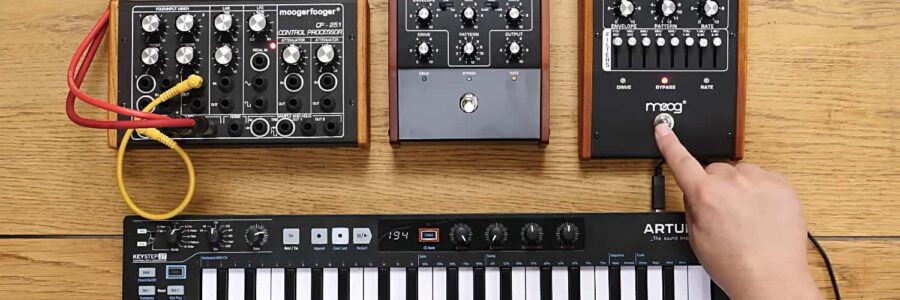
Behringer BM-15 MURF Box + MoogerFooger MIDI MuRF Head-To-Head Comparison


Synthesist Starsky Carr shared this head-to-head comparison between the Behringer BM-15 MURF Box and the device it copies, the classic MoogerFooger MIDI MuRF.

He questions whether he got a broken unit, because of the significantly higher noise level on the Behringer version. “I hope they’re not all like this!” says Carr. “Hopefully it’s a dud – but it should never have got through Q.”

But several early purchases have commented on his video that they had the same issue their units.

Because multiple buyers have reported this issue, it’s possible that there’s a design or production issue with the initial Behringer BM-15 MURF Box batch. We haven’t seen any official word from Behringer on this, but it looks like they have taken down the intro video for the BM-15 MURF Box.

Based on this, Carr’s video appears to be a fair and accurate comparison, based on the Behringer BM-15 MURF Box that’s currently shipping. We will try to share more information, or an updated comparison, if it becomes available.

If you’ve purchased a Behringer BM-15 MURF Box, share your experience with it in the comments!

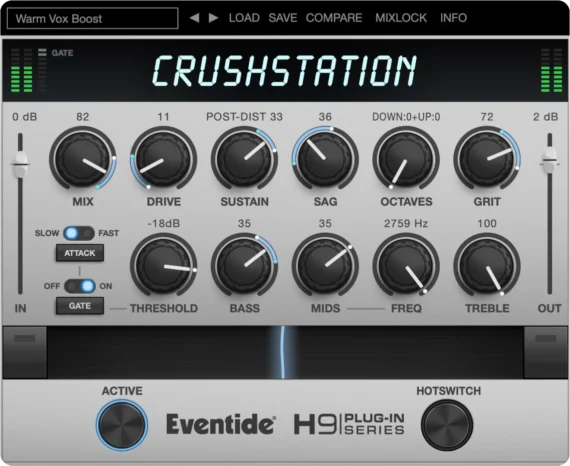
Eventide CrushStation Priced At $99, Now Available For Free


CrushStation delivers everything from ‘creamy saturation to brutal sonic assault’.

Eventide’s CrushStation is typically priced at an RRP of $99 but currently available for no charge, this should be an instant download for anyone looking to expand their collection of plugin effects.

Eventide has a stellar reputation in the effects game that goes back decades, so when the company drops a freebie, it’s always worth a look. CrushStation features the same distortion algorithm that can be found in Eventide’s popular H9 Harmonizer effects pedal.

A stereo distortion and overdrive with a few tricks up its sleeve, Eventide says CrushStation is “capable of everything from pleasing saturation to massively destructive tones”, and it’s not wrong: this is a versatile processor that’ll come in useful across a variety of contexts, from overdriving guitars and sweetening vocals to crushing the living daylights out of a drum break.

Alongside its core distortion algorithm, CrushStation features a handful of additional effects. Compression can be dialled in via the Sustain control, and can be applied pre- or post-distortion, and the Octave control lets you blend in pitch-shifted copies of the signal at multiple octaves above and below its original pitch, much like an octave pedal.

The plugin’s Grit control dials in additional low-end prior to the distortion stage for a gnarly and abrasive tone, while the unique Sag parameter simulates the sonic quirks of poorly-designed tube amps to apply a “sputtery, crushed and broken” quality to the input reminiscent of “the dead and dying gear of times past”. CrushStation also features a three-band EQ and noise gate.

Another interesting feature is CrushStation’s Ribbon control, a macro control that lets you morph between two snapshots of multiple parameter values. This can be automated or controlled via MIDI CC, so you’re able to hook it up to something like your keyboard’s mod wheel for expressive control over CrushStation’s destructive tones. There’s also a Hotswitch button onboard for quickly toggling between two different presets.

Eventide CrushStation is compatible with macOS and Windows and available in VST3/AAX/AU formats.

To download the plugin, follow this link and use the code PIRATE100 at checkout.