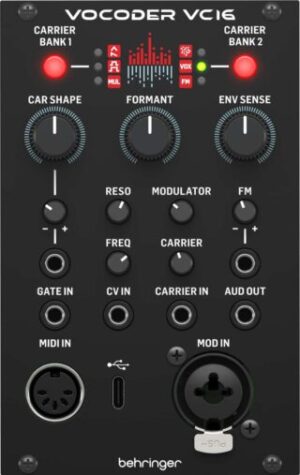
Today, Behringer announces that their latest Eurorack module, the Vocoder VC16, is now shipping from their factory, priced at $99.
Vocoders analyze the spectral characteristics of a modulation signal, like your voice, and then apply those characteristics to a carrier signal. The most common application is for creating classic ‘robot voice’ effects.
The Vocoder VC16 features six engines and three voice polyphony with its internal engine, and it can also work with an external carrier.
Features:
Vocoder with 3 voices of polyphony
6 digital oscillators, including analog modeling, noise, FM, and Vox
4 controls for vocoder response and sound modeling
Synthesis models tailored for Vocoder applications
Carrier shape control
External carrier input with adjustable level control
Line/mic modulator input featuring level control
MIDI input for interfacing with other instruments
USB connector for firmware updates
Eurorack specs: 16 HP, 100 mA +12 V, 20 mA -12 V
The official Behringer Vocoder VC16 intro video:
The Behringer Vocoder VC16 is now shipping from their factory, priced at $99.
It is ‘come to Jexus’ time for Moog Muse owners – sound designer Jexus (sounds-for-synths.com) has announced a 300+ patch sound library for the Muse.
What Jexus shared about the Jexus Moog Muse Soundset:
“The Jexus Moog Muse Soundset contains over 200 brand-new patches, many of which are dual-timbre, so if we add up all the unique timbres (timbre A + B), the library comes with over 300 unique & new sounds.
In my demos I am also playing / demonstrating some factory patches that I made for the Moog Muse. These patches are my favorites, I adjusted / improved them and I wanted to play them “my way”;) You can download the original factory patches for free on Moog’s website. The improved Jexus factory patches are included as a free bonus in the library file that you’re buying.
Many of the presets demonstrated in my Youtube videos are played with the delay set to 12-bit mode to add some grittiness, but when you load the soundset into your Muse, the majority of presets will actually load up as 16-bit to give you a clean starting point experience.
P.S. Let your Muse warm up good before playing these presets. If it does not reach its full / optimal stability, some of the presets may sound a little bit different, especially the ones using FM or extreme resonance settings.”
Jexus Moog Muse Soundset Video Demo:
The Jexus Moog Muse Soundset is available now for $37.90 / €36.90 / £29.90.
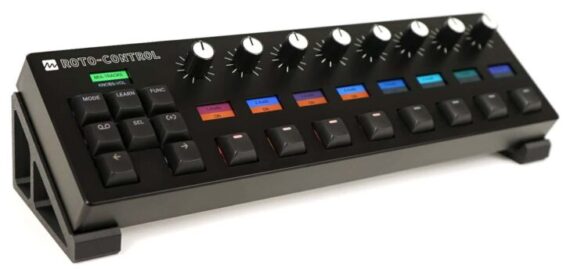
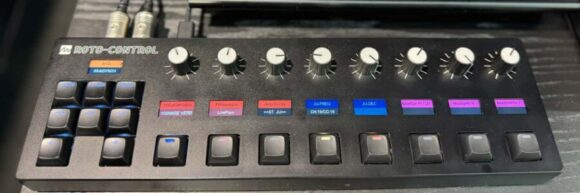
Host Ziv Eliraz – in the latest loopop review – offers his usual in-depth look at the new Melbourne Instruments Roto-Control, a unique MIDI controller with motorized pots.
The Roto-Control costs about $420, and features fully-assignable motorized touch-sensitive knobs, user definable haptics for detailed control, high-res screens that provide easy-to-read labels for every control, and internal memory with storage for over 8000 assignments.
Topics covered:
0:00 Intro
1:45 Overview
2:50 Modes
4:25 Build
4:45 I/O
6:00 MIX mode
7:25 Automation
7:55 PLUGIN mode
8:20 Live learn
10:10 ROTO Setup
10:40 VSTs
12:00 Racks
12:50 Issues
13:05 Automation
13:40 MIDI mode
14:45 MIDI learn
16:50 Motion rec
18:45 Software
19:20 Pros & cons
23:30 Outro
Eliraz notes several issues that he’d like to see addressed:
Automap, at the very least in instrument racks is a must I think, but since Ableton Live devices have so many parameters, it would be great to be able to pre-populate with automap and then customize
Drum rack parameters aren’t remembered across different drums.
If a parameter changes its name, you lose control of it (e.g., Meld, Echo)
Need to rename racks otherwise, ROTO control doesn’t identify the rack properly – though apparently that’s a feature not a bug 🙂
Clock sent out isn’t tracked properly by external devices in the first bar.
I didn’t test this with every Live device so there may be other issues!
Learning 14bit CCs doesn’t work; doesn’t support 14bit CCs with custom MSB/LSB pairs
View the video and share your thoughts on the Roto-Control in the comments!