Archive for February, 2025

WMD Performance Mixer MKII Now Shipping
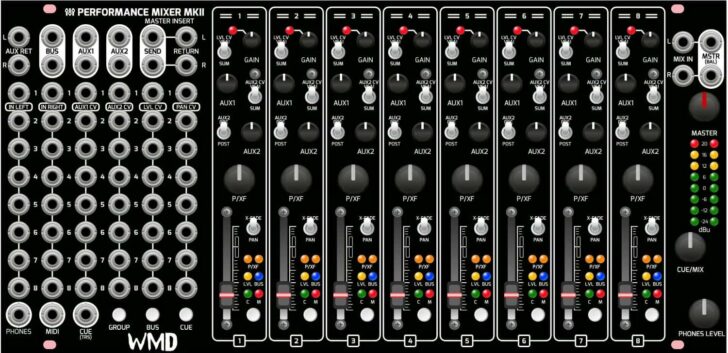

WMD let us know that their new Performance Mixer mkII for Eurorack systems is now shipping.

They say that they’ve shipped the first modules, and plan to ship a lot more in the the late February/early March 2025 timeframe.

Version 1 of the manual for the PM mkII is also available (pdf).

What’s new with the PM MKII and Channels MKII expander since their last update:

Group Recall – There are now two modes for grouped mute, cue, and bus actions.

The new default mode is Group Recall. This allows you to save 8 presets of mute, cue, and bus settings and then recall them by holding group and pressing a channel button. This adds a whole new level of control and the ability to plan changes ahead of time.

The classic mode is Combo Mode, which takes after the original PM. Hold Group, and make any selection you want to change, once you let go, all actions take place.

Channels Routing – The next addition has to do with the Channels MKII expander. It allows you to keep the Channels MKII expander module connected to the PM MKII and selectively route the AUX1, AUX2, and MAIN mix to the PM MKII. So you get independent (or not) submixes on Channels if you want.

For example, the master output can be sent over to the PM MKII’s master output, but then the auxes can be taken out of the PM MKII’s aux summing, so you get 2 independent stereo aux sends just for Channels MKII.

This setting is also digitally recallable with the Group Recall mode, allowing for even more dynamic mixing.

Features:

  • 8 Stereo or Dual Mono Inputs
  • 2x Stereo Auxes
  • Balanced (TRS) Main Outputs
  • Soft Mute Per Channel
  • Group Button for Simultaneous Cue/Mute/Bus routing Changes
  • Pan/Crossfade Switch for dual mono inputs per channel (panned center)
  • Second Bus for Submixing (and/or operation)
  • Stereo Cue Mix Bus (TRS Output Jack)
  • 5mm Headphone Jack with Cue/Mix pot
  • MIDI output sends CCs for Pan, Level, Aux1, Aux2 positions – Capture your mix in your DAW
  • Rear Headers for Pre and Post Fader/Pan outputs to DB25/3.5mm Jacks
  • Clip Indicator on Input Gain Pot
  • LEVEL and AUX2 CV can SUM or operate as VCAs
  • AUX2 can be Pre Fade or Post Fade
  • Channel strips are field replaceable if a pot or fader fails.
  • Expandable up to 24 Stereo Channels
  • Returns Expansion adds 3x AUX return stereo inputs
  • CV control over Pan, Level, Aux1, and Aux2
  • CV flows to MIDI
  • Channel Inserts: Rear cables per channel allow for future insertable effects
  • Firmware update via Memory Card
  • Integrated Soft Start on Power Up

The Performance Mixer MKII is available to pre-order, priced at $1499, with shipping expected in late Feb/early March 2025.
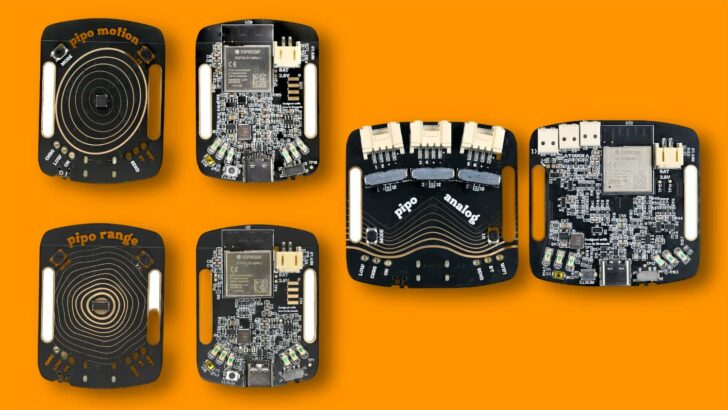

Pipo Interfaces Offer An Open Source Solution For Creative MIDI Control


Developer Rupert Renevier let us know about Pipo Interfaces, a new set of open source MIDI controllers that turn sensor data into wireless MIDI or OSC signals.

Pipo modules are plug-and-play, standalone boards that can be used independently or together, wired or wirelessly. They share many core features: an onboard lithium battery charger, Wi-Fi and Bluetooth LE connectivity, a USB Type-C port, and practical mounting holes.

There are currently three Pipo module designs:

  • Pipo Motion allows you to trigger actions using its spatial orientation, acceleration, taps, or vibrations.
  • Pipo Range can be used for distance sensing and object detection. It can sense hands (like a theremin) or detect bigger objects like walls, obstacles, or people up to a few meters away.
  • Pipo Analog is the ‘Swiss army knife’ of the family. Using standard Grove-type connectors, any signal between 3.3 and 12 V can be used with your Pipo-based project, making it compatible with a long list of existing sensors made for Arduino. The capacitive touch inputs let you create buttons using various common conductive materials or objects: wires, metallic tape, vegetables, conductive paint…or anything else you can imagine.

What Renevier has to say about Pipo:

“Pipo is a collection of three modules aimed at enabling dynamic, live interaction with audiovisual and music software. They turn sensors into standard input devices—in seconds.

Pipo supports MIDI, OSC, and USB HID protocols, ensuring compatibility with a wide range of computing platforms.

The Pipo ecosystem offers a versatile platform for exploring alternative inputs for everything from music to gaming. It provides a configurable open-source sensor solution with a simple browser-based interface.

Whether you’re a beginner or a pro, you’ll find a reason to love Pipo—it gives superpowers to creatives and is a time-saving, feature-rich solution for makers.”

Details on pricing and availability are to come. You can sign up for notifications on Renevier’s project page.

MARS Polyphonic Tube Synthesizer Now Shipping


Eternal Engine Electronic Music Instruments shared this brief demo of the MARS Polyphonic Tube Synthesizer, before shipping it out.

Here’s what they have to say about it:

“MARS – the first polyphonic synthesizer based on vacuum tubes. The power and flexibility of oscillators based on the famous R-2R DAC TDA1387, combined with the original fully tube audio path based on the APPARATUS synthesizer circuit, allow you to create a wide range of sounds from punchy aggressive FM leads and acid basslines to soft classic pads and strings.

The synthesizer supports full software control and easily integrates into any DAW using the original plugin. All synthesizers are assembled by hand and produced in limited quantities.”


Specifications:

  • Compact RACK format, 5 units high
  • Fully tube audio path based on the APPARATUS synthesizer
  • Four oscillators operating in modes: BASIC (Sine, Triangle, Sawtooth, Fixed Pulse Width 1/2, 1/4, 1/8); PULSE; ENSEMBLE and Noise with Hi-Pass and Low-Pass filters
  • Voltage-controlled tube filter of the second order with self-oscillation with overload
  • Voltage-controlled amplifier, following the traditional architecture of tube opto compressors
  • Triode asymmetric overdrive
  • Indicator based on Nixie lamps
  • Full software control using the plugin
  • Four channels of 4xCV and Gate for integration with Eurorack format synthesizers
  • External Input for processing the audio signal of external audio devices
  • Two HADSR envelope generators with pre-delay and multiple retriggers
  • Sub-audio frequency generator LFO with restart and synchronization Clock, smooth waveform transition sawtooth-triangle-sawtooth, pulse-square-pulse, as well as Sample & Hold and Noise with reconfigurable Hi-Pass and Low-Pass filters
  • Auto and continuous modes of portamento / legato
  • Mono, duo, and 4-voice polyphony modes
  • Flexible 4-channel modulation matrix
  • Plugin for integration with DAW
  • PC connection with galvanic isolation

Audio Demos:

The Eternal Engine EMI MARS Polyphonic Tube Synthesizer is available now for $2,199.