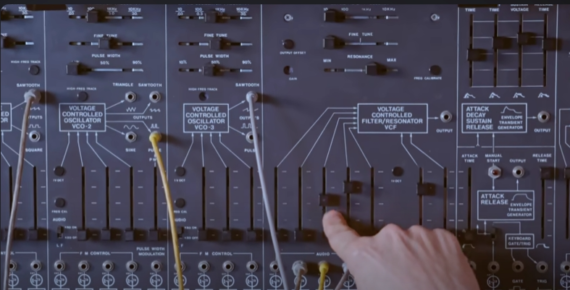
Composer & synthesist Anthony Marinelli – in his latest video – takes an in-depth look at how to recreate the sliding melody synth sound from Roy Ayers’ classic track, Everybody Loves the Sunshine.
Marinelli demonstrates how to recreate this sound using the ARP 2600, but notes that you could get similar results with a Minimoog and other synths. Along the way, he covers the oscillator tunings and performance techniques that are essential to creating this classic sound.
He also explores how the track’s arrangement makes space for the lead, complementing the song’s rhythm section.
Watch the video, and share your thoughts on it in the comments!
Amazon Spring Promotion Effective February 25, 2025 to March 10, 2025, Find Your Favourite!
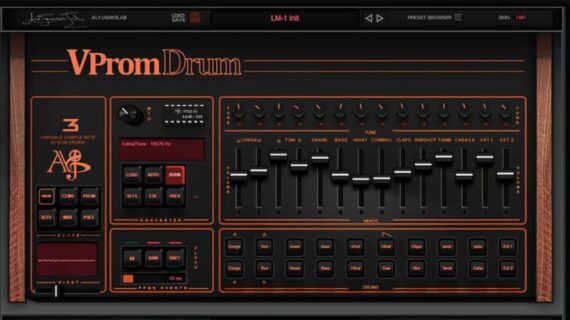
Aly James Lab has introduced VProm 3.0, a major update to their virtual instrument for Windows & Mac
VProm is a virtual instrument that emulates the EPROM-based drum machines of the 80s, primarily the LM-1. In addition, it lets you create and load custom EPROM sound files.
VProm 3.0 video intro:
New in VProm 3.0:
Enhanced circuit emulation:
Enhanced circuit emulation, including some OB DMX voice cards features like VCA and filter tracking, customizable start and end memory points and loop control.
Upgraded voltage-controlled CEM filters with expanded controls—adjust trimmer, decay, pulse time, envelope response, or keep it simple with legacy mode (just one pulse control).
µLaw madness
Real-time variable sample rate decoding of EPROM sound data using the precise AM6070 DAC response, ensuring unparalleled authenticity.
New unique µLaw DAC real-time transfer response customization per voice—allowing precise control over the µLaw decompression ratio. By tweaking the transfer function slightly, you can subtly refine the response to better approximate real-world variations between original AM6070 DAC chips. At extreme settings, this feature transforms into a unique powerful creative transient / distortion shaper: with ratios closer to 0.5/1, quieter details are brought forward significantly, while values above 1/1 enhance snappiness and impact, delivering a uniquely dynamic and tonal character, a unique feature taking advantage of digital processing while keeping some level of authenticity.
Sample/Convert/Burn
VProm now features a built-in EPROM creator, allowing you to generate custom EPROM binary files without any external tools and ready for use in VPROM or hardware drum machines.
Import any .wav file and sample it just like in the classic hardware days. The resampling process uses a crude emulated R2R ADC with tweakable input settings and home-made tweaks* before capturing at ? 27 kHz. If the original .wav file rate is less or equal than 27 kHz, resampling is bypassed. You can also disable the resampling stage if needed.
Once sampled, preview the file with µLaw 8bit (12bit quality) compression applied or save it directly as a µLaw-encoded .bin EPROM file.
Maximum EPROM size is 64K ? 2.5 seconds @ 27Khz —larger sampled .wav files will be automatically truncated to fit during sampling.
Make your own:
New EPROM Management Panel – Manage all 14 custom EPROMs in one window with **waveform visualization**, direct loading on click, real-time auditioning, quick reset, and more.
New EPROM Library Browser – Easily access, preview, and organize your custom and vintage EPROMs from a dedicated internal library.
New .VPromKit Format – Save and reload an entire custom EPROM set as a .VPromKit file, allowing you to switch drum kits instantly without affecting other settings.
That ‘Mythical Feel’:
Authentic 48 PPQN Timing Emulation – Recreates the subtle groove and feel of vintage drum machines. Unlike modern high-resolution clocks (~960 PPQN), this low-res 48 PPQN pulse locks trigger events in real-time, syncing tightly to your DAW. The effect is subtle but noticeable, especially on swung or loose beats, adding that extra bit of human feel without overhyping the impact.
Real-Time Clock Drift – Recreates the natural clock drift found in vintage drum machines, where internal clocks were never perfectly stable. Unlike the subtle effect of the 48 PPQN clock, this feature introduces a more noticeable, organic timing shift, mimicking the imperfections of classic hardware. With a tweakable drift range from 1ms to 40ms, you can achieve anything from a realistic analog-style drift to a more exaggerated laid-back groove, similar to a drummer playing with extreme looseness and feel.
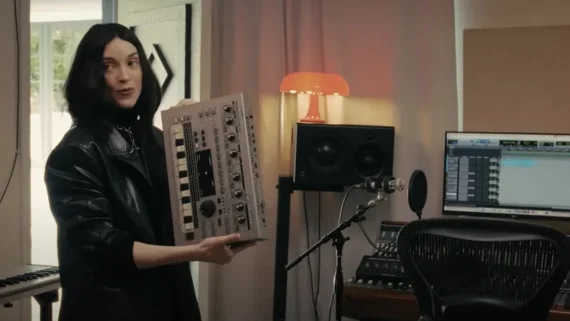
Grammy-winning artist and producer Annie Clark – better known under the stage name St. Vincent – has invited Reverb into her studio space to show off some of her gear, discuss her recording ethos and witness a spontaneous jam session.
In the video, Clark describes how she went through a phase of “thrifting” gear on Reverb, deliberately seeking out unpopular pieces of equipment in the hopes of sticking it to the haters. “I had a period of time where I was [doing] the Reverb equivalent of thrifting,” Clark says. “I was like, ‘I know people think that these are terrible machines but I’m going to prove that they’re great!’”
The machine Clark is referring to is an MC-303, a Roland instrument released in the late ‘90s that was the first (and worst, according to some) to bear the name “groovebox”. Equipped with a sample-based sound engine, the MC-303 was packed with classic Roland sounds but earned its fair share of criticism thanks to an unintuitive interface and limited sonic tweakability.
Clark admits that she ultimately came to the conclusion that the MC-303 actually “might be kind of terrible”, but that she still found a place for it on the track Big Time Nothing, from her 2024 album All Born Screaming, after spending hours scrolling through the machine’s presets. “I can’t show you [the sound] because it’s totally broken,” she says, “but it’s also not worth repairing”.
Another of Clark’s Reverb finds is a vintage Omnichord, the quirky chord-strumming Suzuki instrument released in the ‘80s. While the (also busted) Omnichord OM-37 shown in the video has no MIDI outputs, Clark says that she made use of a later, MIDI-equipped version of the instrument on several tracks from her 2009 album Actor, sending out “harp-like sweeps” via the Omnichord’s strum plate to trigger other synths in her studio.
Later in the video, Clark embarks on a spontaneous jam using some of her favourite synths and drum machines. Programming a pattern on her Arturia BeatStep Pro sequencer, Clark sends this out to the Vermona DRM1 MKIII drum machine and layers that with snare rolls produced by the Roland TR-8S, mixing the results live on a vintage Boss KM-60 mixer that Clark loves for its distortion.
Clark says that although she loves to jam as much as the rest of us, messing around in the studio can sometimes make her lose sight of her ultimate goal: writing songs. “Sometimes doing this stuff is a distraction from sitting down and writing the song I know I need to write,” she says. “My main passion is actually writing songs – that’s immensely harder than just dicking around in the studio all day”.