Archive for February, 2025

$99 JamCorder Is “The World’s First Automatic Piano Recorders”
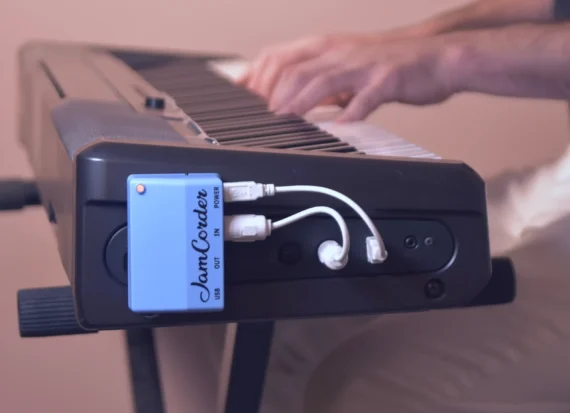

Jamcorder automatically records everything you play on piano – so you’ll never lose a spontaneous jam again

Billed as “the world’s first automatic piano recorder”, Jamcorder constantly records MIDI from your piano to be played back on its mobile app.

Imagine this: you’re sat in front of your digital piano noodling away, and a bolt of inspiration strikes. Caught up in the creative flow, you embark on a fifteen-minute jam that sounds like some of the best material you’ve ever improvised. As you finish jamming, you suddenly realize you’ve no idea how to recreate what you just played – and you didn’t hit record.

Jamcorder is a nifty little device that makes sure this will never happen again. Designed by pianist and software engineer Chip Weinberger, this small blue box sticks to the side of your piano and automatically records everything you play via MIDI, storing up to 25,000 hours worth of jams on its 16GB microSD card that can be wirelessly synced to your phone via Bluetooth or exported to your DAW.

Jamcorder’s mobile app lets you listen back to your impromptu performances and spot where you might have played a bum note on its keyboard visualizer. You’re even able to bookmark noteworthy improvisations using a handy shortcut on your piano; just hit the highest five black keys twice and Jamcorder will bookmark that recording in the app. It stops recording automatically after a few seconds of silence, so you won’t end up with countless hours of empty MIDI files stored on the device.

The USB-powered gadget can hook up to your digital piano or keyboard via 5-pin DIN MIDI or USB, and it’s equipped with Bluetooth MIDI, so you can use it to connect your piano to your DAW wirelessly. There’s also a MIDI out port, so you can connect Jamcorder and a computer or tablet to your piano at the same time.

Here’s the official intro video:

While it seems to be aimed at players that like to improvise, Jamcorder could also be a useful way of tracking and reviewing practice sessions for pianists trying to improve their skills. And while Jamcorder is primarily aimed at piano players, it’ll work with any MIDI-equipped instrument and records all MIDI messages on all 16 channels, so it’ll come in handy for recording synth jams too.

JamCorder is priced at $99. Find out more on Jamcorder website.
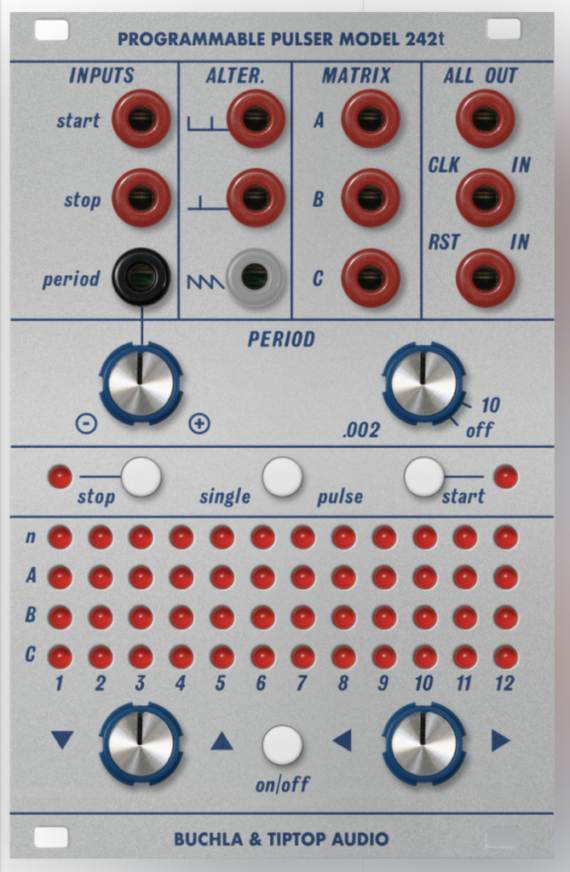
Tiptop Audio & Buchla 242t Programmable Pulser Module Now Available


Tiptop Audio let us know that the Buchla 242t Programmable Pulser is now available to order.

The 242t is essentially a reissue of the classic 200-series Buchla module from the ’70s in Eurorack. It’s a 3-channel trigger sequencer with a few tricks up its sleeve. The most notable change from the original is that the 242t uses an LED matrix, instead of the pin matrix of the original.

Here are some videos that showcase the 242t in action. The first video, via Stazma, offers an overview and musical demo of the 242t’s features:

The following video, via Buchla expert Todd Barton, is intended to be a video manual for the module:

Finally, Giorgio Castelli (Dexba) demonstrates the range of the 242t by using it as an audio-rate oscillator:

TheTiptop Audio + Buchla 242t Programmable Pulser is available now for $199.Tiptop also let us know that the Quad Lopass Gate Model 292t is also now available to pre-order for EU and UK customers, priced at $350.

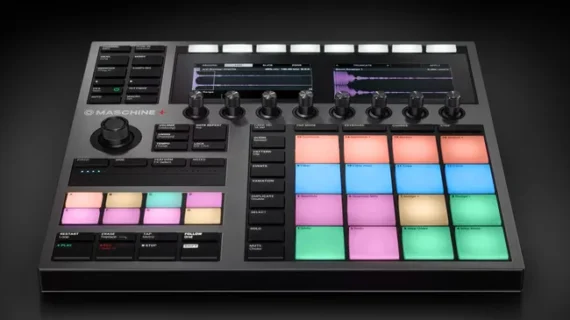
Native Instruments Responds To Customer Concerns, Announcing Maschine 3, Kontakt 8 Support & Play Series Instruments For Maschine+ : ” We’ve heard your frustrations “


Reads the company’s post on its community forum.

Back in January, Native Instruments announced that it would be bringing Play Series instruments and Expansions sound packs to the Akai MPC platform and teaming up with Akai and a number of other leading controller brands to integrate their products with the NKS control standard.

That news understandably ticked off a number of users of Maschine+, Native Instruments’ standalone groovebox and rival to the MPC, that are currently unable to use those very same Play Series instruments on their own devices.

More broadly, the decision was interpreted as a sign that the company may be shifting its focus away from Maschine altogether, a platform that hasn’t seen a hardware update in five years, and only recently received a long-awaited software update that many of us found somewhat disappointing.

Native Instruments has responded to those frustrations with a post shared to its own community forum on January 31 that reinforces the company’s “strong commitment” to Maschine and provides some clarity on when Maschine users can expect the updates they’ve been hoping for.

Native Instruments has confirmed that Maschine 3 – the recent update to its DAW-like companion software for the Maschine controller range – will be coming to Maschine+ standalone in 2025. First, the company says, it’s catching up by releasing Maschine 2 for Maschine+, which enters beta this week and will bring a number of Native’s desktop effects to the standalone groovebox, while allowing users to change sampling rate and buffer size to expand compatibility with USB class-compliant audio interfaces.

Further down the line in Q2, Maschine 3 for Maschine+ will bring support for Kontakt 8, the latest version of Native’s sampler plugin, to Maschine+ users, along with a “selection of full Kontakt instruments” that includes Play Series titles. Also on the way is a “highly requested” bounce-to-audio feature that will allow Maschine+ to run CPU-heavy instruments like Kontakt efficiently.

Maschine 3 introduced stem separation to the Maschine platform for the first time. Native Instruments says it is exploring the possibility of bringing stem separation to Maschine+’s standalone mode, but notes that the “technical complexity” involved means that it may not be available in the upcoming releases. However, Maschine+ users will be able to separate stems on desktop and import these projects to their hardware following the forthcoming updates.

The post also touched on the controversy surrounding Native Instruments bringing Play Series instruments to the MPC platform before its own hardware. “Some of you may have seen our recent Play Series and Expansion content releases on the MPC platform, in partnership with our friends at Akai Professional,” the post reads. “This collaboration allows us to bring high-quality sounds to more creators, but we want to reinforce our strong commitment to Maschine.

“It’s also important to note that the Play Series MPC Editions are not direct ports of the original Play Series instruments. Instead, they are custom-built for the MPC platform, utilizing its sample engine and featuring MPC-specific presets. This makes them a unique experience tailored to the MPC workflow, rather than a replication of the Play Series desktop version.”

Read the full post on Native Instruments’ website.