Archive for February, 2025

Native Instruments Claire: Avant Creates Avant-garde Soundscapes Out Of ‘The Crown Jewel Of Grand Pianos’
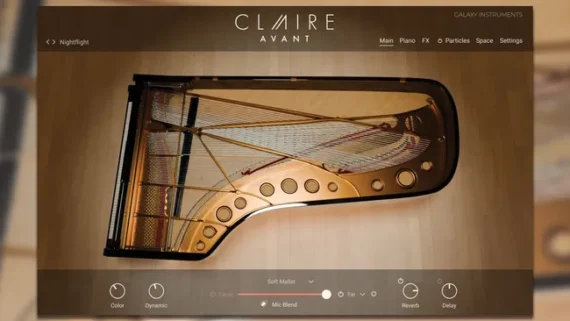

Native Instruments released Claire, late last year – a virtual instrument for Kontakt 8 that captured the sounds of a Fazioli F308, a 10-foot Italian concert grand that also happens to be the world’s largest grand piano.

This week, Native Instruments has announced Claire: Avant, a new “avant-garde” instrument also featuring the sounds of the F308, but with a more experimental spin. Designed to be “as expressive as it is unconventional”, Claire: Avant is said to explore a variety of unorthodox articulations and preparations that reveal unexpected resonances, overtones and percussive textures in the piano.

Recorded with the piano’s lid off, these unique playing techniques and sound modifications alter how the strings are struck, plucked or dampened, expanding the instrument’s sonic palette beyond traditional piano tones. Each note has been equipped with up to 13 different velocity zones and three round robins in order to create a “living, breathing” instrument that creates evolving and complex sounds.

Claire: Avant’s samples can be processed with the onboard Particles engine, a granular effect that generates shimmering textures, or a selection of additional effects that includes reverb, delay, compression, saturation and EQ. Its sample library also features a number of different microphone placements that can be blended via a slider on the instrument’s interface.

Claire: Avant walkthrough video:

Native Instruments has described the F308 as “the crown jewel” of pianos, an instrument that delivers “immense power and harmonic richness”, with an extended string length that contributes to its exceptional clarity and deep low-end. Rather unusually, the F308 equipped with a fourth pedal, which allows the player to soften the sound without changing its timbre, by reducing the distance between the strings and the hammers.

Claire: Avant is available now for $99/€99/£89, or as part of a bundle with the Claire grand piano.

Find out more on Native Instruments’ website.
BBC Radiophonic Workshop – Electronic Music History, Reimagined! Now Available


Spitfire Audio’s latest instrument captures the sound of the Radiophonic Workshop, the hugely influential BBC department “purely for making bonkers noises”

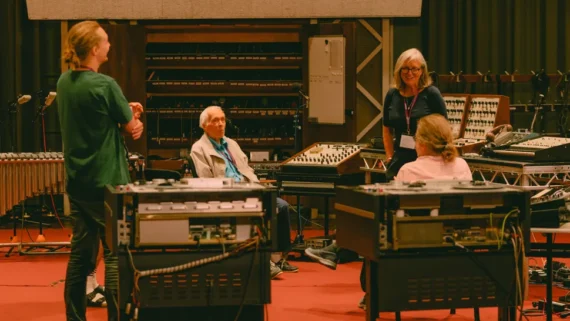
The BBC Radiophonic Workshop was a department at the British Broadcasting Corporation that not only produced electronic sound effects and music for beloved shows such as Doctor Who and Tomorrow’s World, but also played host to some of the most influential innovators in early electronic music.

Set up by pioneering noisemaker Daphne Oram, the Workshop acted as a centre for creative and technological experimentation over four decades, before closing shop in 1998. Since then, the Workshop’s archives have been quietly gathering dust at the BBC’s Maida Vale Studios: until now.

New Sound Library Brings BBC Radiophonic Workshop To Your DAW

With unprecedented access to the BBC Radiophonic Workshop’s archives, tools and hardware, Spitfire Audio has developed a sample library made up of authentic sounds from this vast archive of sonic experimentation. A diverse collection of one-shots, loops and multi-samples that features vintage synths, tape loops, found sounds and long-forgotten archival content, the library has been bolstered by the addition of new recordings made by a number of Workshop members and associates.

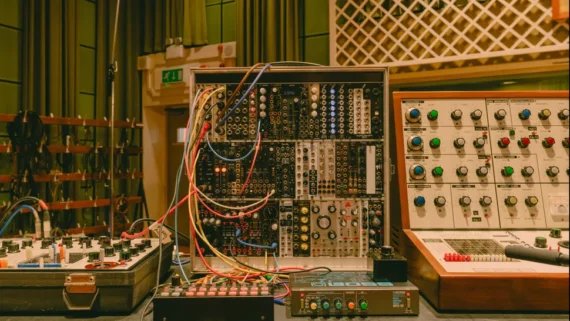
The library is divided into six sections – Archive Content, Found Sounds, Junk Percussion, Tape Loops, Synths and Miscellany – and contains sounds from an array of vintage kit that belonged to the Workshop, including an EMT turntable and Rogers loudspeakers made especially for the BBC, Maida Vale’s plate and spring reverbs, along with modular synthesizers, tape machines, an EMS Vocoder, Roland Vocoder SVC-350 and an Eventide H-3000.

The recordings can be played, sequenced, and processed via Spitfire’s SOLAR engine, which lets you blend, pitch-shift and filter the instrument’s hundreds of presets using its high- and low-pass filters and shape them using its dual ADSR envelopes. There is also an array of effects on board that includes delay, reverb, chorus, flanger, phaser and distortion.

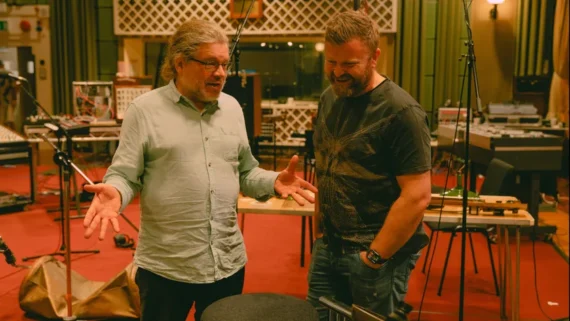
“As a kid born in the 1960s, I realised there was a department at the BBC that was purely for making bonkers noises. It blew my mind!”, said composer, sound designer and Radiophonic Workshop archivist Mark Ayres.

“I’m the youngest member of the core Radiophonic Workshop – and I’m 64! We’re not going to be around forever. It was really important to leave a creative tool, inspired by our work, for other people to use going forward. I hope we’ve made an instrument that will inspire future generations.”

Features:

  • Authentic sounds from the BBC Radiophonic Workshop archives.
  • Deeply sampled one-shots, loops, and multi-samples.
  • New recordings and experiments by Workshop members and associates.
  • Spitfire Audio’s powerful SOLAR engine with gate sequencer and vast effects suite.
  • Wide range of sounds, including archival content, found sounds, junk percussion, tape loops, and vintage synthesisers.
  • 13 different signal chains used for sound capture.

Spitfire Audio BBC Radiophonic Workshop VST is available now priced at an introductory discount of £119/€143/$159 until 6 March (normally £149/€179/$199).

Find out more on Spitfire Audio website.

Universal Synth Editor and Controller – Synth Bridge For All


Developer Momo Müller has announced a new Universal editor and controller for everyone.

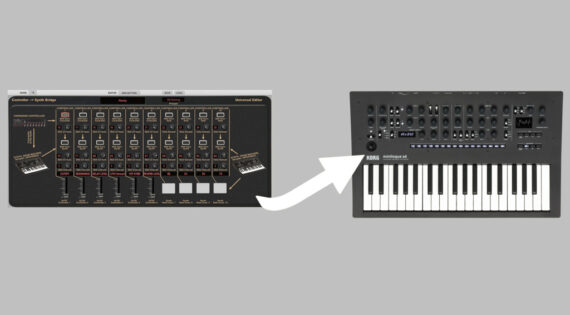
The ‘Universal Synth Editor and Controller – Synth Bridge’, can be used with any synth, sampler, drum machine or other device that can be controlled via MIDI Control Change data, aka MIDI CC.

Momo has ensured ease of use for even the most Luddite synth players because all you have to do to create your own special version of the controller is to use the built-in MIDI Learn function. Select the on-screen control, wiggle, press or slide the hardware controller you want to map to it and it’s captured.

You can then save that collection of settings for easy recall at any time. Now, as we all well know, anything that claims to be universal is rarely ever that but I suppose the word ‘universal’ is more compact than “Controller for most instruments”

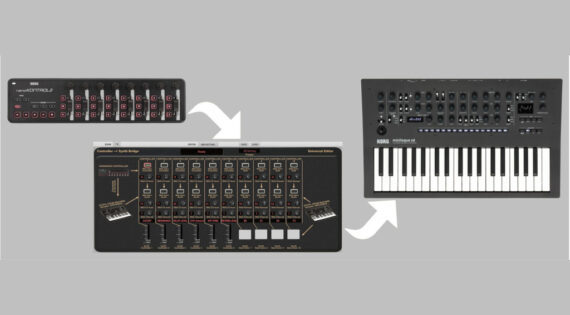
It can also function as a ‘Bridge’ between a hardware control surface, like a KORG nanoKONTROL, for example, and your favourite hardware synth across the studio. The software, as the name suggests, acts as a translation bridge between your controller and synth so that you can tinker with the synth settings using your desktop device.

Here’s the official Universal Synth Editor and Controller demo video:

The software has 10 controller ‘slots’ (six faders, four ‘pads’), each of which can be set to control specific functions of your choice using the settings in each ‘slot’. The software comes in a broad range of versions to suit all users.

The Universal Editor and Controller Synth Bridge is available for:

  • PC: As VST2 and Standalone for 32bit and VST2, VST3 and Standalone for 64bit Windows.
  • MAC: As VST2, VST3, AU and Standalone, compatible with MAC Intel and Silicon.

It is available now, priced at € 6.90 / $ 7.00