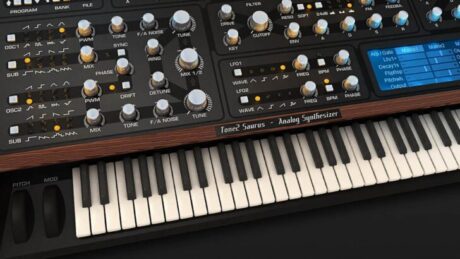
Tone2 has introduced Saurus 4, a major update to its virtual analog synthesizer instrument for Mac & Windows that they say delivers “true analog sound”, without compromises.
According to the developer, “Saurus is an extremely authentic emulation of analog synthesizers. It covers all aspects of the most famous and expensive synths, but without disadvantages.”
New in Saurus 4:
GUI with 20 different sizes (with and without keys).
Native support for WQHD, 4K, 5K and 8K UHD displays.
GUI can be scaled from 66% up to 300% by clicking in the lower right corner.
Reworked and enhanced graphics.
Smoother animations and more responisve controls.
Support for hardware-acceleration.
Ultrasharp graphics with enhanced HiDpi and Retina Display support.
Automatic detection of the ideal GUI size.
Completely rewritten GUI code.
More contrast for the LCD displays.
The animations are faster and smoother.
Fine-tuned some coordinates in the interface.
Re-sizing the VST3, Standalone and Audiounit works more reliable.
Fine-tuned some colors.
Removed the demo-version timeout and added a voice-over.
Patch browser can now also be opened by clicking on ‘BROWSER’ or the display on the upper left.
A finger is shown when hovering over ‘BROWSER’ to indicate that the control is click-able.
Enhancements – sound quality:
The audio-engine now uses 64-bit precision instead of 32-bit, which results in a higher sound-quality.
Slightly enhanced sound of the automatic micro-tuning.
Enhanced sound of the Reverb
Saurus 4 is available with an intro price of $69 (normally €119). The update is available for free for all Saurus users.
Windows and Mac (VST/VST3, AU) is available now with an intro price of €59/$69
Bitwig has announced that its Bitwig Studio 5 is now available as a beta release.
Here’s what’s new:
5 new multi-segment envelope generators –
Segments is an envelope with global time-scaling and loop modes. Use it as a Grid and Polymer module or as a modulator controlling any parameter.
Curves is an LFO modulator and Grid module that can sync to the beat time or groove.
Scrawl is an anti-aliasing oscillator for The Grid and Polymer.
Slopes is a pattern sequencer for The Grid with stereo phase options.
Transfer is a waveshaper for transforming incoming audio or other signals in The Grid.
New modulation options – Any control source — including audio or CV signals — can affect any device or plug-in.
Now modulators aren’t limited to devices — they can grab the mixer and project controls as well.
You can now animate your entire mixer with any of 40+ modulators, from step sequencers to audio sidechains or envelopes. One LFO can modulate any device on the same track, as well as the track’s panning, sends, and other parameters.
If you move that LFO to the project level, you can add modulations to all devices, channel strips, and transport targets, too. Want to sidechain the Fill button, or MSEG the project tempo? Now you can.
New Performance Gestures
Browse Better – the new browsers implement a modern, flexible approach that does away with hierarchies. You can search through devices, presets, and everything else — including different types of media or content — all in one screen.
Other changes:
A brand new onset detector that makes audio work better from the moment you drag it in.
Spanish and Korean language support for Bitwig Studio.
Keytrack+ modulator has an embedded MSEG editor window so you can draw your settings or load and save curves.
And for morphing control signals, you’ll love
Wavetable LFO modulator/Grid module
An overview of Bitwig Studio 5 performance features: