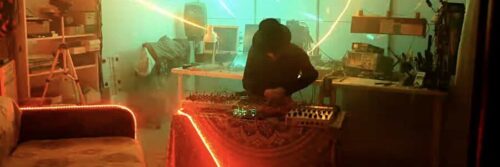
Synthesist and sound designer Richard Devine shared this short demo of his first experiment with the new SOMA Illuminator, an eight-channel converter that turns Eurorack and analog CV signals into a voltage that can drive LEDs and LED strips, so you can control a light show in sync with your live performance.
Another demo, via SOMA’s Vlad Kreimer:
Illuminator is compatible with standard 12V LED strips that are widely available. LED strips are flexible and typically come with adhesive on the back, so they can be attached to your Eurorack case, synth stands, walls at the venue and more.
Illuminator can also run anything that accepts DC 12V, with a current up to 0.5A. You can hook up anything from motors, electromagnets to old-fashioned filament bulbs.
Illuminator accepts all types of CV signals, in the range from 3 to 20 volts. Each of the eight channels contains an individual trimmer pot that defines the sensitivity of the channel. It not only adjusts the optimal input range for connected CV sources, but it can also set the brightness of each LED strip. The default factory setting for all trimmer pots is made for the range of 5V, compatible with most gear out of the box.
CV signals can be connected to Illuminator using Eurorack mini-jacks or PULSAR-23-like pins and alligator clips. PSU DC IN and all outputs are standard DC sockets.
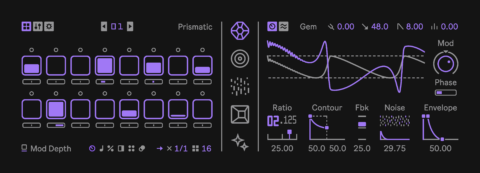
Fors recently released a new hardware-inspired groovebox for Ableton Live, Opal.
Opal features four synthesizers, built-in effects and a powerful step sequencer.
What they say about it:
“Opal is an instrument made for intricate pattern creation. With parameter locks, probability, conditionals, ratcheting, independent track length, time division and traversal, it’s a breeze to program exciting patterns.
Opal comes with four distinct, highly malleable, synthesizers and two sequenceable effects. While the synths are tailored for creating drum sounds, it’s up to you to choose where, or if, the line between percussion and melody is drawn.”
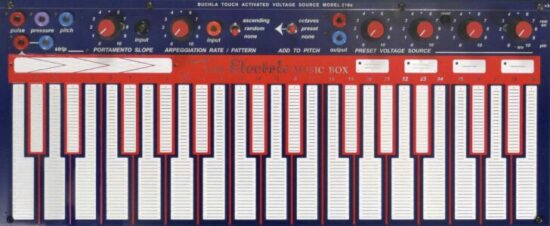
Buchla USA has announced the availability of the Touch Activated Voltage Source LEM218 v3, an updated version of the capacitive touch controller, first introduced in 1973 with the Music Easel.
While the LEM218 may look like a traditional piano keyboard, it’s a flat surface that sense touch and features controls and capabilities that enable it explore possibilities that would be impossible with a traditional keyboard.
With version 3, the LEM218 v3 Touch Activated Voltage Source has been updated with stable, modern electronics and the connectivity to integrate with your Buchla, MIDI, and Eurorack gear.
Features:
Capacitive Touch – The sensitivity and accuracy of the redesigned touch bed means the lightest touch will produce triggers and control voltages for your setup. Buchla says that the new texture not only improves the sensing, but provides a satisfying tactile experience. Pressure is an expressive output, adding an extra dimension to the control.
MIDI – the LEM 218 v3 gives you a unique interface for playing your existing MIDI gear and soft synths. Each touch outputs note name, channel pressure, and velocity for every note, along with sustain controls from a pedal. Polyphonic MIDI mode lets you play chords. The touchstrip can act as a pitch bend control, or as a mod wheel for additional expressive control. Configurable using the front panel controls, you can send notes and controls on any MIDI channel. You can also send the LEM MIDI, and it gets converted to voltages and gates for Eurorack and Buchla control.
Euro-Compatible – Even if you don’t have any Buchla products, the LEM 218 v3 is designed to work with your Eurorack-compatible gear. Four 3.5mm jacks output 1v/octave pitch, 0-8 volts pressure, touchstrip voltage, and gate outputs for use with Eurorack equipment.
Arpeggiator – A pulse input allows the arpeggiator to be driven by external inputs and are allowed to interact with the automated notes to make the pattern more complex. Additional controls allow you to blend different patterns and randomness.
Immediate Control – The classic preset voltage knobs offer several possible ways to shift your sounds into new territory. Not only can the knobs be used for quick access to voltages for your patch, they can control arpeggiation modes and octave shifting. Pads output pulses for additional control.
Customizable – you can quickly customize the velocity and pressure sensitivity, MIDI channel, knob behavior, and more.