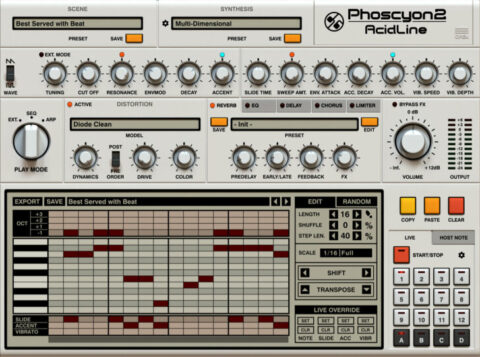
D16 has introduced Phoscyon 2, a software emulation of the legendary Roland TB-303 bassline synthesizer that they say “has been taken to entirely new heights.”
While D16 says that the signal path has been designed to “achieve an unprecedented level of emulation accuracy”, Phoscyon 2’s design otherwise diverges significantly from the classic 303, adding a robust FX chain tailored to “acidic squeaks” and an original sequencer and arpeggiator, designed to make it easy to edit patterns and perform with them live.
Other features include:
Substantial factory content
Over 800 presets and patterns in factory content
Several UI sizes and HiDPI support for better screen fit
Perhaps, you already have installed drum machine plugins, but do any of them contain ‘beat pizzas’ and a wheel that can be used to slice up rhythmic pies? Perhaps not.
Modalics has introduced Beat Scholar, a new software drum machine that they describe as “the ultimate rhythmic playground”.
Beat Scholar is academic and slightly intellectual sounding name.
Beat Scholar trend provides a deep-pan programming experience that enables you to slice up your rhythmic pies as you wish. With Beat Scholar you get a step sequencer full of circles (beats), which can be subdivided individually to create interesting rhythmic variations.
In addition, each sound does not have to be on its own lane – you can place any drum on any beat, or any part of a beat. Adding bars and changing measures and beat values can all be done with just a few clicks, giving you huge scope for experimentation.
This unique programming interface is accompanied by a sampler, which comes stocked with more than 250 sounds that cover classic drum machine tones and more esoteric timbres. You can also drag and drop your own samples, tweaking them with a variety of controls and effects.
Features:
Presents a unique & intuitive way to explore subdivisions, measures & create drum patterns.
Divide beats into up to 42 slices and combine multiple drums on the same beat.
Any drum can be placed anywhere
Over 250 carefully curated samples, from classic drum machines & acoustic samples to synthesized drums hand-crafted especially for Beat Scholar (by Yonatan Meltzer)
Load your own samples with an easy drag n’ drop interface.
Built-in FX section to get you started quickly.
Easy MIDI file export – drag directly from the plugin’s interface to your DAW.
Use Beat Scholar to output midi to any instrument or even to hardware drum machines!
Standalone, VST3, AU, AAX.
Mac Intel & M1 / Windows Compatible.
Tested Hosts: Logic, Pro Tools, Cubase, Ableton Live, Reaper
Beat Scholar looks like a lot of fun, and the good news is that there’s a 14-day trial version for you to try. It runs on PC and Mac in VST/AU/AAX formats, and is available now for the introductory price of $79 (regular price $99). Find out more on the Modalics website.
Cong Burn have announced the release of Strokes v3.3, a new version of their MIDI sequencing plugin. Previously only available as a M4L device, Strokes is now available in VST3/AU format for use in any DAW.
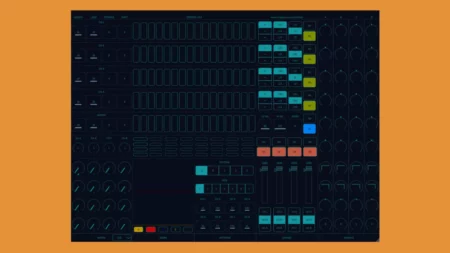
Strokes v3.3 is an all-in-one sequencing powerhouse, capable of generating complex and evolving rhythms, melodies and modulation using a variety of different methods, through seven interconnected modules.
If you are experiencing creative gridlock in your DAW’s stock sequencer or finding yourself stuck for ideas, Strokes is an instant inspiration generator that will throw out unexpected ideas in just a few clicks.
Strokes is made up of seven individual modules; Grids, Logic, Shares, Weights, Patterns, Notes and Matrix.
Grids offers four channels of sequencing that are capable of switching between euclidean rhythm generation and a conventional step-based layout, while Logic is made up of four channels equipped with algorithmic rhythm generators that create new patterns by running the sequences in Grids through a variety of logic operations.
The mathematically disinclined – will be glad to know that this is complex in principle, but simple in operation: essentially, the sequencers will output rhythms and melodies based on a variety of mathematical rules that change in response to values entered on the dials.
Shares uses probability-based faders to reduce the likelihood of notes entered in Grids and Logic being generated, and Weights, a set of four variable envelope followers.
Patterns can store up to five device-wide snapshots, making it possible to switch between multiple versions of the same arrangement, while Notes enables you to store seven sets of eight note values that define the notes played by Grids and Logic.
And, Matrix is a parameter sequencer that can automate MIDI CC data across a 16-step grid. When used in conjunction with Grids and Logic, this can achieve the kind of parameter locking associated with Elektron products.